
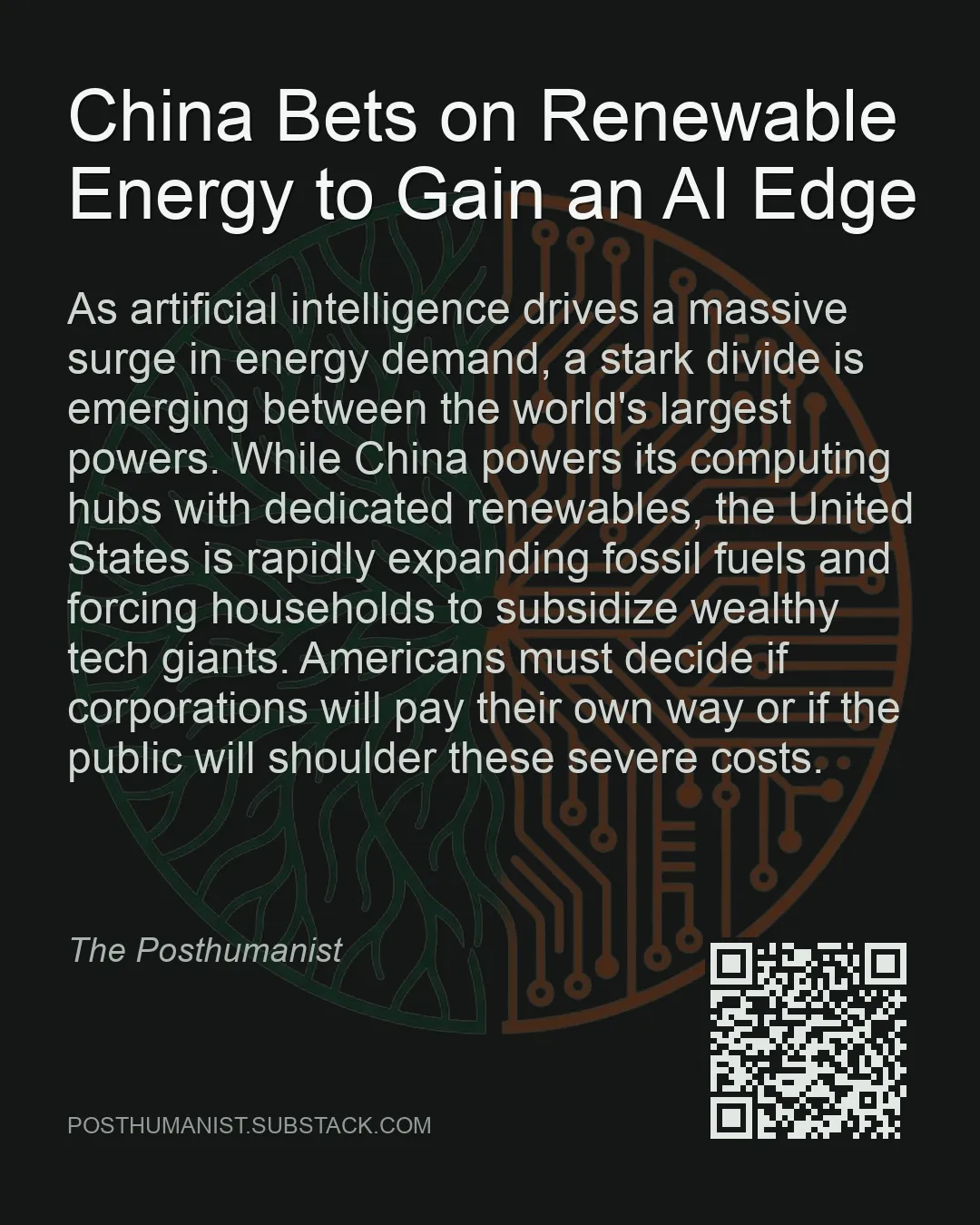
Drawing on recent reporting by Andrew Liu at Inside Climate News, along with data from Bloomberg, Wood Mackenzie, Lawrence Berkeley National Laboratory, the Sierra Club, and The Washington Post, we have to confront the physical reality of the internet. Artificial intelligence is routinely sold to the public as something weightless, living in an abstract place called the cloud. But this cloud is heavy. It is built out of concrete, steel, copper, and silicon, and it requires a massive, constant flow of electricity to function. The computing needs of artificial intelligence are now forcing a massive expansion in power generation across the globe. How different governments meet this demand reveals exactly what they prioritize, both for the living world and for everyday people.
China is choosing to link its computing expansion directly to its massive domestic renewable energy industry. As Liu reports for Inside Climate News, Beijing expects wind and solar to supply more than 80 percent of the power for new facilities in its primary computing hubs. We can already see this happening on the ground. Envision Energy, the second-largest wind turbine manufacturer in the world, recently opened a data center campus in Ulanqab, Inner Mongolia. This facility runs entirely on renewable electricity fed directly to the site. While the first phase is relatively small—about 120 megawatts according to Bloomberg—Envision intends to scale it beyond 2 gigawatts. Because this campus relies on dedicated transmission lines rather than pulling from the general grid, the company claims its customers can lock in electricity rates about 20 percent below standard prices for a decade.
The national numbers illustrate a stark division between the world's two largest economies. Based on figures cited by Inside Climate News, China added roughly 540 gigawatts of power generation in 2025, and over 80 percent of that came from renewable sources. During the same period, the United States added about 54 gigawatts, with roughly 60 percent coming from renewables. The scale of future demand is staggering. China expects its computing centers to consume about 800 terawatt-hours of electricity by 2030, a massive leap from 170 terawatt-hours in 2025. To supply this power while attempting to meet its climate goals, the national plan requires annual renewable generation to climb from about 4,000 to roughly 6,000 terawatt-hours. Because China surpassed its 2021 through 2025 generation targets by around 20 percent, this new goal appears mathematically possible, even if nothing is certain.
In the United States, the federal government is moving in a vastly different direction. The Trump administration recently eliminated a requirement that artificial intelligence data centers located on federal land must be paired with clean energy. At the same time, computing demand is climbing rapidly. Lawrence Berkeley National Laboratory estimates that American data centers consumed 176 terawatt-hours in 2023, and that figure could reach anywhere between 325 and 580 terawatt-hours by 2028.
Utility companies plan to burn a lot of natural gas to fill that gap. Wood Mackenzie projects that the United States could add between 13.2 and 16.4 gigawatts of gas-fired power plants every year from 2026 through 2035. That represents more than triple the average annual additions we saw from 2023 to 2025. Power plants built today will run for decades. The decisions made right now will lock in vast amounts of pollution far into the century. A recent Sierra Club analysis estimates that by 2030, the pollution coming from new off-grid American data centers could match the entire annual emissions of Mexico.
This divergence between the two nations is rooted in how their respective economic and political systems function. When tech companies connect gigantic data centers to the American power grid, utility monopolies usually have to build new power plants and transmission lines to handle the load. The core issue is who actually pays for that infrastructure. Under most current utility regulations, these immense costs are spread across all customers. This forces ordinary households to subsidize industrial infrastructure built exclusively to enrich some of the wealthiest corporations on the planet. State regulators are currently arguing over these costs, and the debate warrants intense public scrutiny. People are already angry. A Washington Post, ABC News, and Ipsos poll found that 72 percent of Americans oppose building data centers in their communities. While the poll does not explicitly detail their reasoning, local fights over these facilities consistently revolve around surging power bills, massive water consumption, and the relentless noise of cooling fans destroying the quiet of their neighborhoods.
China has largely avoided this specific type of local friction, but we have to look honestly at why. The state dictates exactly where data centers go, heavily favoring remote regions like Inner Mongolia, far from major population centers. David Fishman of the Lantau Group told Inside Climate News that data centers have not driven up retail electricity prices for Chinese citizens. He also pointed out that China can afford to build green data centers simply because the state is pouring money into building massive amounts of every kind of power plant imaginable, not just renewables. Yet a lack of visible public opposition never equals true consent. In a deeply centralized, authoritarian system, local communities whose land, water, and grazing territories are swallowed up by industrial development have virtually no mechanism to object or defend their homes. We can learn from how China scales its renewable technology, but a top-down system that silences its rural populations is absolutely not a model to replicate.
It is also completely premature to declare that China has secured any permanent advantage in artificial intelligence. Kyle Chan of the Brookings Institution correctly points out that the United States still leads in advanced computing models and chip design, and China is currently just testing whether its renewable energy supply can actually keep pace with its industrial ambitions. As Chan observes, both nations are simply playing to their respective structural strengths.
The glaring contrast between these two systems forces Americans to answer a fundamental question about corporate power. If artificial intelligence requires a historically unprecedented amount of electricity and resources, we must decide who foots the bill. We have deeply practical ways to manage this without forcing the public to pay for it. Regulators could enforce large-load tariffs that legally require data center operators to pay the full cost of the grid upgrades they trigger. Communities could demand that new tech facilities bring their own power, financing their own wind and solar generation before breaking ground. Furthermore, any private computing project that utilizes public land or receives taxpayer incentives should be legally bound to run on zero-emission energy. The digital economy is entirely dependent on physical resources scraped from the earth. The United States can absolutely build advanced computing systems without shifting the severe financial and environmental costs onto everyday households and the living world, but only if it intentionally forces the corporations driving this demand to pay their own way.

Comments