
In Nazi Germany, the Nazi Party assigned a Blockleiter, or block leader, to roughly 40 to 60 households. The job looked administrative: relaying party directives, assisting with ration cards, and keeping tabs on residents. In practice, the warden watched neighbors for signs of disloyalty or difference and reported them. The neighborhood itself became a means of control.
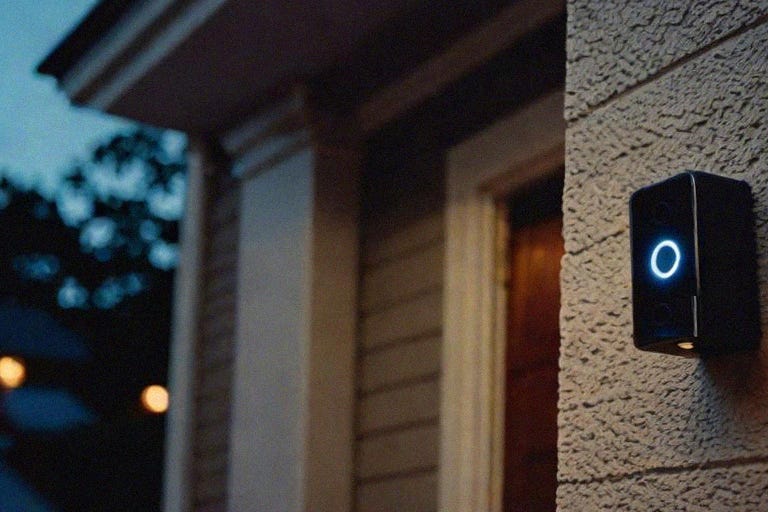
Nobody appoints block wardens in American suburbs. We buy the equipment ourselves: doorbell cameras, Amazon’s Sidewalk network, and apps like Nextdoor and Ring’s Neighbors. The comparison has limits. A Nextdoor post is not a Gestapo file. But the basic mechanism, neighbors watching neighbors and reporting what looks out of place, is worth taking seriously.
Friction removed
Neighborhood watch groups used to take effort. You went to meetings, walked patrols, and talked to people face to face. That effort filtered out some idle or bias-driven complaints. An app removes it. Someone on their couch can watch a motion clip of a stranger on the sidewalk and share their suspicion with thousands of neighbors in seconds.
These apps do real good: lost pets get found, wildfire and outage alerts spread fast. But posts about “suspicious” people reach an audience instantly and draw heavy engagement, and the person in the video has no say in how they’re described.
Who looks suspicious
“Suspicious” is never defined, so users fill it in with their own assumptions. In 2015, reporting by the East Bay Express in Oakland documented a pattern of Nextdoor posts flagging Black residents for walking, driving, or knocking on doors. Nextdoor responded in 2016 by requiring descriptions beyond race—specifically two other physical descriptors—and later added reminders to be kind. The company reported these UI changes reduced profiling posts by 75 percent. These were real changes, but they target wording, not the instinct behind the post.
The scholar George Lipsitz calls that instinct the “white spatial imaginary”: the long-standing assumption that certain neighborhoods, especially affluent suburbs, belong to white residents. Elijah Anderson describes how Black Americans in such “white spaces” are often treated as outsiders until they prove otherwise. A white man pausing to look at houses is admiring them. A Black man doing the same is “casing the block.” The language stays race-neutral (”didn’t seem like he belonged”) while the outcome does not.
Redlining and restrictive covenants were laws and lending policies, and Nextdoor is neither. But it lets residents enforce a similar idea of who belongs without ever writing it down.
The pipeline to police
From 2016 to June 2020, Nextdoor offered a “Forward to Police” feature that sent safety posts straight to participating departments. Nextdoor dropped it during the 2020 protests, citing its anti-racism work and low use by police. It kept other tools, including direct messaging with law enforcement.
Ring built a more direct pipeline. Its “Requests for Assistance” program let police ask camera owners for footage without a warrant until civil-liberties criticism led Ring to end it. In September 2025, Ring brought the idea back as “Community Requests,” routed through police-tech companies, starting with Axon. A planned integration with Flock Safety, the license-plate surveillance company, was announced in October 2025 and canceled in February 2026, days after a Super Bowl ad for Ring’s AI-powered “Search Party” feature showed a neighborhood’s cameras scanning the streets together. Ring says the Flock integration never launched. Community Requests is still running, and Ring has also introduced “Familiar Faces,” a facial recognition feature.
Even without a forward button, the sequence is familiar. A camera catches a teenager on the sidewalk. The owner posts the clip asking, “Does anyone know this kid?” Neighbors fill in a story. Someone calls 911 with video and a sense that the whole street agrees. When police show up expecting a threat, the person on the sidewalk bears the risk.
Top-down and bottom-up
Americans readily call China’s grid management system dystopian. It divides neighborhoods into grids—typically covering 300 to 500 households in urban areas—and assigns workers to monitor them for disputes, unregistered visitors, and dissent. The criticism is fair. But China’s system also relies on resident volunteers, and ours relies on residents almost entirely. The difference is who sets the rules: in China, the state; here, property values, fear of crime, and the companies that profit from both. The result for the person being watched is similar: they know someone is filming.
What to do instead
Cameras and feeds don’t make a neighborhood safe. Knowing the people on your street does. That means learning names, not reviewing clips. Some practical steps:
Before posting about a person, ask whether you’d post it if they looked like you.
Describe behavior, not appearance, and skip the post if there’s no behavior to describe.
Decline police footage requests that don’t come with a warrant, and know what your camera’s settings share.
Ask your city council what data-sharing agreements your police department has with Ring, Axon, or Flock.
The block warden didn’t disappear. The job moved into an app, and we signed up for it ourselves.
Originally published on Substack.
Comments