
On a weekday afternoon in downstate New York, my wife drove into a nearby town to drop off a box of household stuff at a local charity. It took ten minutes. She parked, carried the box in, got back in the car, and came home.
A few hours later my phone rang. The car is registered to both of us, and they called my number. It was an investigator from the town police. Someone driving a car that roughly matched ours, same make and color, had hit a commercial building downtown and driven off. More calls came that evening, each more aggressive than the last. They insisted my wife bring the car to the station right away so detectives could look at it, which left us no time to talk to a lawyer first.
Later that night, a state trooper showed up at our door. He said the same thing: my wife needed to bring the car to the station, or there would be consequences.
By the next morning we’d talked to two attorneys, and both said the same thing. Leaving the scene of an accident is taken seriously in New York, and if police decided we were avoiding them, things could escalate to an arrest. The safest move was to bring the car in and let them look.
So we spent the early evening at the station while officers went over every seam, panel, and bumper. They found nothing: no scratch, no dent, no transferred paint. Once they were satisfied my wife hadn’t hit anything, they went back inside. Nobody apologized for the threat. We just never heard from them again.
How they found us
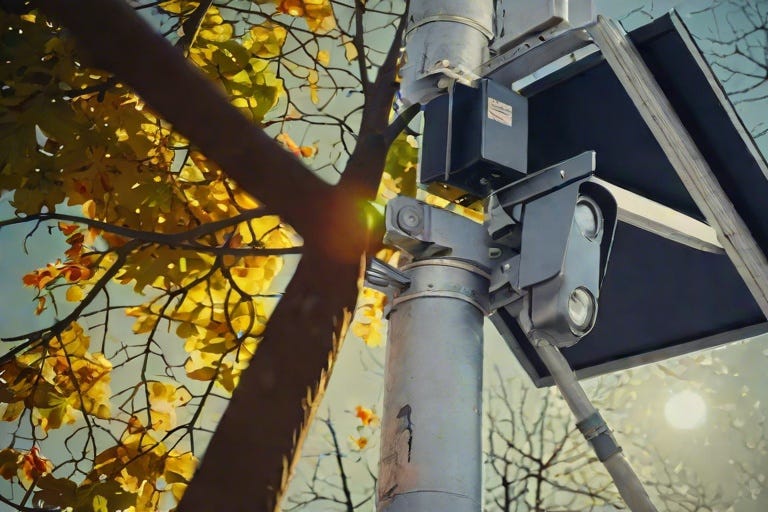
No witness at the crash site pointed police to our car. An automated license plate reader made by Flock Safety had logged our plate somewhere else in town that day. Police pulled the registration, saw a car that sort of matched, and went from there.
The camera didn’t show that my wife hit a building. It showed that her car was in town that day, and that’s all. And the records don’t stay in town. Through a Freedom of Information Law request to our county sheriff’s office, I obtained the network’s sharing list and a 30-day search audit from late August to late September. The county had connected its cameras to 1,313 outside organizations—90% of them outside New York, including police departments and sheriff’s offices across Texas, Florida, Georgia, and Alabama, alongside private corporations like Lowe’s, Home Depot, and the local mall. In that single 30-day window, the network logged 606,457 searches—about 14 every minute—including more than 11,500 for routine traffic infractions and nearly 187,000 with no case number attached at all.
Police have always been allowed to notice who’s out in public. What’s new is scale. One officer can’t remember every car that went past an intersection for a month. A camera network can, and it keeps that record for every driver whether or not they’ve ever been suspected of anything. The Supreme Court recognized something similar in Carpenter v. United States in 2018, ruling that police generally need a warrant to get historical cell-phone location data. Courts haven’t settled whether license plate databases deserve the same protection. Meanwhile, the default has flipped. Police no longer start with a suspect and gather evidence. They start with everyone who drove through town and work backward.
For us, a vague camera hit was enough to put the burden on my wife. Legally she was presumed innocent, but in practice she was treated as guilty until she handed over the car. We were fortunate to have two lawyers we could call on short notice who didn’t charge us. Plenty of people don’t have anyone they can call like that, and plenty of people would panic with a trooper at the door at night. For them, a bad lead like this could easily end in an arrest.
Flock’s defense
Flock has grown fast in suburbs and rural towns, selling solar-powered cameras to police departments and homeowners’ associations. The pitch is simple: put up our cameras and crime goes down.
The backlash has grown too. Towns and cities across the country have canceled their contracts or let them expire, citing cost, lack of oversight, and misuse. In July, the Los Angeles Police Department let its contract lapse, citing “serious concerns around civil liberties and civil rights,” though it’s still negotiating with the company. Texas and Florida have both moved to end their relationships with Flock. This month, Reuters reported that the company is cutting about 18% of its workforce, roughly 270 people, as opposition mounts. Flock says it was a voluntary buyout, not a layoff. And this week, speaking at TechCrunch’s Disrupt conference in San Francisco, CEO Garrett Langley pushed back: “If we want to live in a society where, if you commit a crime, you have a higher probability of being held accountable, we shouldn’t pause progress.”
Calling it “progress” does a lot of work in that sentence. A private company building a searchable record of where everyone drives isn’t an advance in what people can do. It’s a much more efficient version of something very old: police asking ordinary people to explain why they were somewhere.
The cameras don’t fix police mistakes. They create more of them, and faster. License plate reader errors have led to innocent drivers being pulled over, sometimes at gunpoint. In Aurora, Colorado, in 2020, police held a Black mother, her 6-year-old daughter, her teenage sister, and two young nieces at gunpoint, ordering them onto the pavement and handcuffing some of them. A plate reader had matched her SUV’s plate number to a stolen motorcycle from Montana, and officers never checked the state or the vehicle type. The city later paid $1.9 million to settle the case. Dozens of officers have been arrested, fired, or pushed to resign for misusing Flock’s database, often to track people they knew personally, including ex-partners.
What we can do
We don’t have to pick between privacy and safety. Crimes get solved by real investigative work and by communities where people know and trust each other. Covering residential streets with private cameras doesn’t do that.
Pushing back works. In a rural township just north of us, residents found out cameras had gone up without the town board ever approving them, and they got them taken down. Here, after months of people showing up at public meetings, asking questions on the record, and confronting the sheriff and prosecutors directly, our county announced it’s dropping Flock entirely.
Vendors like to present mass surveillance as inevitable. It isn’t. Local governments sign these contracts, and they can cancel them. My wife spent an evening proving she hadn’t done something because a camera saw her car in town. Our county won’t be doing that to anyone else.
Originally published on Substack.

Comments