
Want to know why climate policy feels stuck? Look at what the big environmental groups won’t talk about.
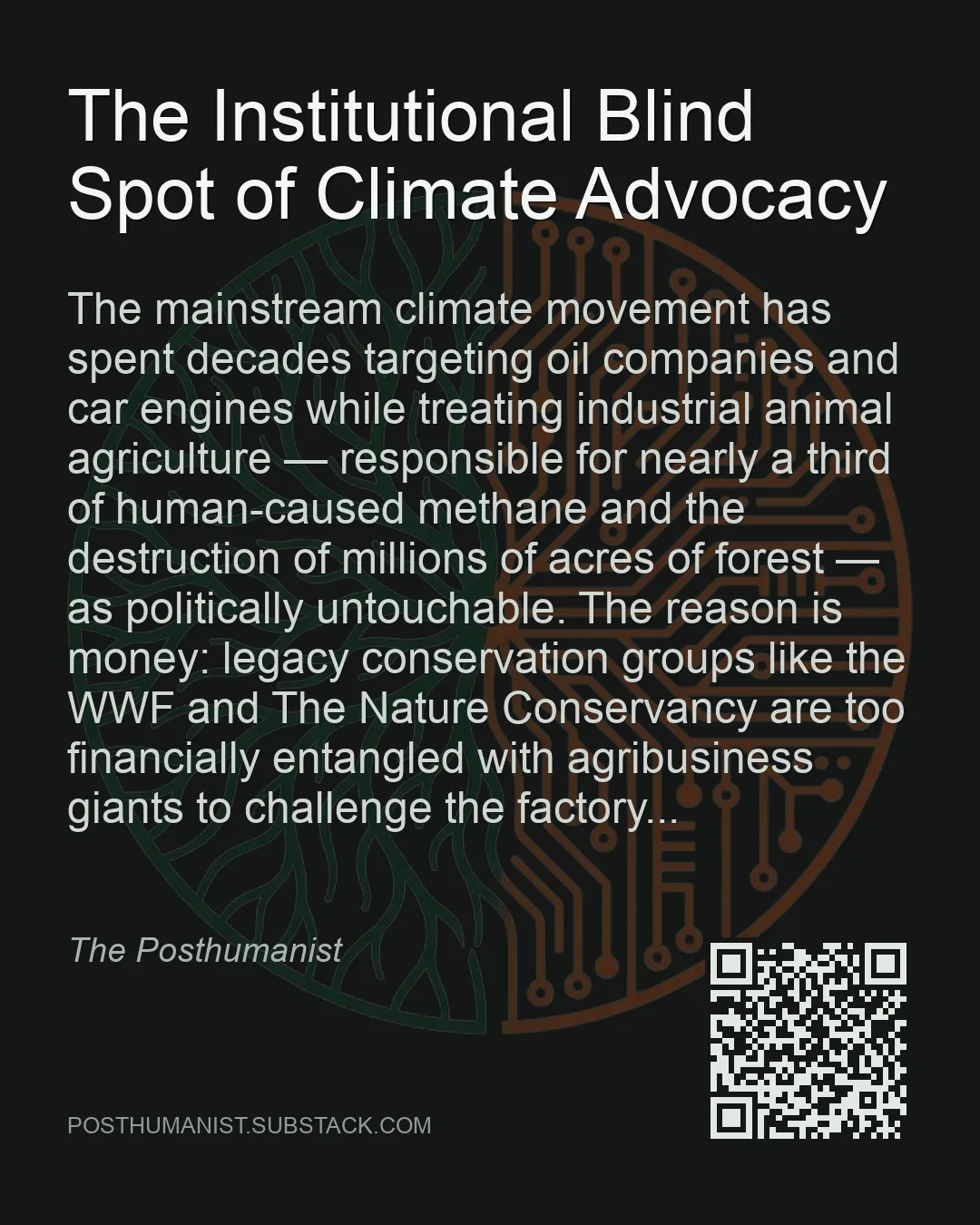
For decades, the mainstream climate movement has operated under an unwritten rule: target the fossil fuel companies, critique the internal combustion engine, demand solar on every roof, but treat what sits on people’s dinner plates as an untouchable private sanctuary. Every conversation about emissions and land use stops dead at the farm gate.
The data makes this silence indefensible. According to benchmarks compiled by the UN Food and Agriculture Organization and Our World in Data, livestock occupies nearly 80 percent of the world’s agricultural land while delivering less than 20 percent of our calories. Most of that acreage is grazing pasture, but industrial feedlots also eat up roughly a third of all global crop harvest. We grow hundreds of millions of tons of corn and soy, pour in massive volumes of water, feed it all to billions of penned-up animals in contract barns, and get back a fraction of the food energy we started with. Livestock alone accounts for roughly 32 percent of human-caused methane.
Yet the major conservation groups barely touch this reality.
Instead of pushing to wind down factory farming, organizations like the World Wildlife Fund and The Nature Conservancy routinely partner with corporate agribusiness giants like Cargill, JBS, and McDonald’s. They sign off on voluntary sustainability pledges and champion biogas digesters. A digester catches a small amount of methane from manure lagoons at an industrial feedlot. It does nothing about the millions of acres of forest cleared in South America for feed crops. It does nothing about contaminated runoff leaking into municipal drinking water. And it does nothing to free up the hundreds of millions of acres of land we actually need back for wildlife and for forests that soak up carbon.
Why the institutional silence? Money. These legacy organizations depend on major donors, corporate philanthropy, and corporate board members who view meat as a personal lifestyle choice rather than a subsidized industrial machine. Challenging an oil executive is comfortable politics for a conservation non-profit; challenging the breakfast habits of their own donors is not.
The distortion goes deeper than private philanthropy. Factory farming survives because the public balance sheet absorbs its true costs. Billions of dollars in state and federal agricultural subsidies flow directly into subsidized grain, livestock insurance, and environmental cleanups for industrial manure spills. If meat producers were forced to pay for their own feed grain without public price supports, their own clean water, and their own waste disposal, the retail economics of factory-farmed protein would collapse overnight. Consumers aren’t choosing cheap meat in a free market; they are buying an artificially cheapened product propped up by tax dollars.
The fix isn’t complicated. Stop handing public money to industrial livestock operations. Shift those subsidies into plant protein, fermentation-made dairy and egg proteins, and direct financial help for contract farmers who want to convert their barns out of the poultry and swine racket. Let the vast expanses of marginal grazing land grow back into native forest, prairie, and wetlands. Freeing up that land is our most effective, immediately available natural carbon sink.
And stop treating animals that feel pain and fear as mere industrial inputs. A conservation movement that claims to defend the living planet while giving corporate cover to the confinement and slaughter of billions of animals has lost its moral footing.
You cannot solve an ecological crisis while protecting a machine this cruel, this wasteful, and this propped up by corporate subsidies.
Originally published on Substack.
Comments