
I'll probably lose some readers over this, including people who agree with me on most things.
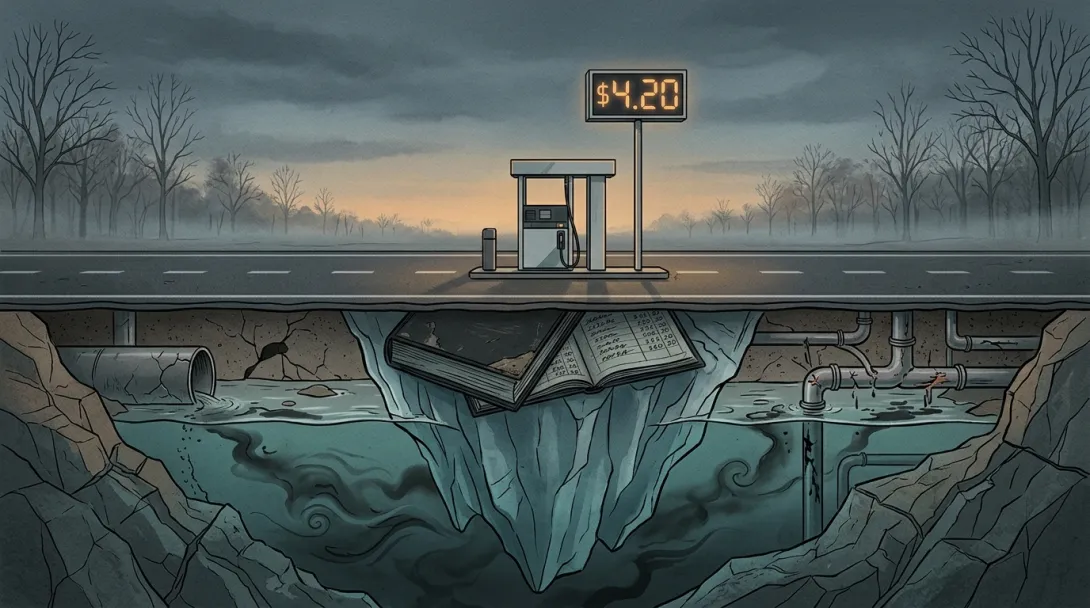
Gas is averaging about $4.20 a gallon. That is a record high for autumn, and we are four days away from the midterms. This is the worst possible moment to argue that fuel is underpriced. I am going to do it anyway.
First, let's look at the objections, because they are fair:
- It sounds elitist. Most people did not choose suburban sprawl. They were priced out of walkable neighborhoods. Now they drive 45 minutes each way just to keep their jobs. Telling them gas should cost more sounds like a lecture from someone who works from home.
- It is politically toxic. Politicians who raise fuel costs usually pay a heavy price. France introduced a fuel tax in 2018, and it sparked the yellow-vest protests. Canada tried sending regular rebate checks to households to balance out its consumer carbon tax. Even with that money returned, the government scrapped the tax in 2025 under intense public backlash.
I take both objections seriously. Even so, neither one changes what a gallon of gas actually costs our society.
The price on the sign is not the whole price
When you fill up at the station, you pay for drilling, refining, shipping, and the retailer's markup. You do not pay for the wider damage. That unpaid tab includes:
- The climate damage caused by the carbon you burn.
- The chronic health problems caused by tailpipe exhaust, such as asthma and cardiovascular disease. Public health researchers link this traffic pollution to more than 40,000 premature deaths across the United States every single year.
- The washed-out roads, flooded culverts, and storm repairs that local taxes have to fix after severe weather strikes.
In 2022, global fossil fuel subsidies reached $7 trillion, according to the International Monetary Fund. That equaled roughly 7% of the entire global economy that year.
Most of that $7 trillion is not direct government cash handed out to oil drills. More than 80% comes in the form of "implicit subsidies." That simply means the gap between what you pay at the pump and the unpaid bill left behind in dirty air, healthcare bills, and climate chaos.
We still pay that bill. We just pay it through higher health insurance premiums, hospital visits, increased local property taxes, and rising national debt instead of at the nozzle.
When pump prices spike, politicians often respond with gas tax holidays. Or they tap the Strategic Petroleum Reserve, releasing emergency crude oil stockpiles meant for national crises. These moves do not make gasoline cheaper. They merely hide the true cost and shift the bill somewhere less visible.
Why price relief backfires
Elections happen every two to four years. Climate costs build up over decades. That mismatch pushes elected officials toward short-term relief, and that relief creates two major problems:
- It removes the pressure to adapt. When governments constantly step in to push pump prices back down, there is little urgency to expand public transit, build regional rail, electrify our heating, or fix outdated zoning rules.
- It props up demand for oil. We artificially stimulate consumption at the precise moment physical reality demands that we consume less.
None of this helps working families escape car dependence. It simply makes staying trapped inside that system slightly cheaper from month to month.
What happens when policy pushes: the US vs. Europe
I wrote about this divide recently in The Transatlantic Electric Divergence.
Europe pushed forward. The European Union set strict fleet-wide greenhouse gas targets for car manufacturers. Automakers had to produce affordable electric models, or they faced billions of euros in regulatory fines.
National governments stepped in to help consumers make the leap. France launched a "social leasing" program, which let lower-income commuters lease compact electric cars for around €100 to €150 per month. In Germany, fully electric models accounted for 34.5% of all new car registrations this past September.
At the same time, high European fuel taxes push gas prices to between $7.50 and $9.00 a gallon. When pump prices reflect that reality, buying an efficient car becomes simple household math.
The United States pulled back. Federal electric vehicle tax credits expired in September 2025. Federal regulators then rolled back tailpipe emission rules and stopped penalizing automakers who miss corporate average fuel economy targets. Washington also blocked California's long-standing legal authority to set tougher clean-fleet rules for its own state.
American automakers took the hint. They slashed their electric production targets and shifted their assembly lines back toward high-margin gas trucks and conventional hybrids. As a result, the electric vehicle share of US sales slipped to roughly 6% this year.
Washington also blocks low-cost competitors from abroad. A 100% tariff on imported Chinese electric cars, paired with strict limits on foreign software, keeps some of the world's cheapest electric vehicles completely off American roads. That trade barrier shields legacy Detroit carmakers from competition, while leaving working-class drivers with fewer budget-friendly options.
People make the switch when the cleaner alternative is cheaper. Europe designed its regulations and incentives to make that happen. The United States chose to protect gasoline.
The goal is not expensive gas. It is not needing gas.
Right now, oil prices are hovering near $100 a barrel. That volatility is driven by military conflict and shipping risks around the Strait of Hormuz, thousands of miles away. Tying everyday household budgets to the stability of distant geopolitical chokepoints is reckless policy for working families.
The goal should never be making gasoline cheaper. The goal must be making gasoline irrelevant. We can achieve that by focusing on four clear priorities, in order:
- Build real transit alternatives first. Invest public capital in frequent regional rail and dependable bus routes so that getting to a job does not require owning a depreciating vehicle.
- Reform local zoning laws. Allow neighborhood grocery stores and everyday services closer to residential areas, so buying basic food does not require two tons of machinery.
- Allow affordable clean vehicles into the market. Lower the protectionist trade barriers that keep sub-$20,000 electric hatchbacks out of American showrooms.
- Price carbon gradually and return the revenue directly to the public. If we put an honest price on fossil fuel pollution, every dollar collected should go straight back to households as regular, visible dividend checks. Canada's misstep showed that if rebate checks are not frequent and obvious, people will only notice the pain at the pump.
Cheap gas makes a great campaign slogan. But until pump prices reflect real-world physics, we will continue paying the difference through declining health, overburdened local tax budgets, and an unstable climate.
P.S. (Satire): Yes, I considered sitting on this essay until after the midterms. I may believe in the cold laws of thermodynamics, but I understand political self-preservation. Even armchair critics know better than to drop a manifesto against cheap gas while voters are standing outside the polling booth.
Originally published on Substack.

Comments