
This is a compressed social media blurb. Does it sound like a real person talking straight? What's ? The draft contains AI rhetorical habits and lists are disguised as colon setups.
The draft uses plain words and avoids academic jargon. Are there any cases where the same thought is repeated? Are the statistics accurate to their target, and do you cite real numbers and names?
Avoid cheap anti-tech slang. Apply empathy and human dignity unanimously, without tribal selectivity or conspiratorial deflection.
Here's the revised body:
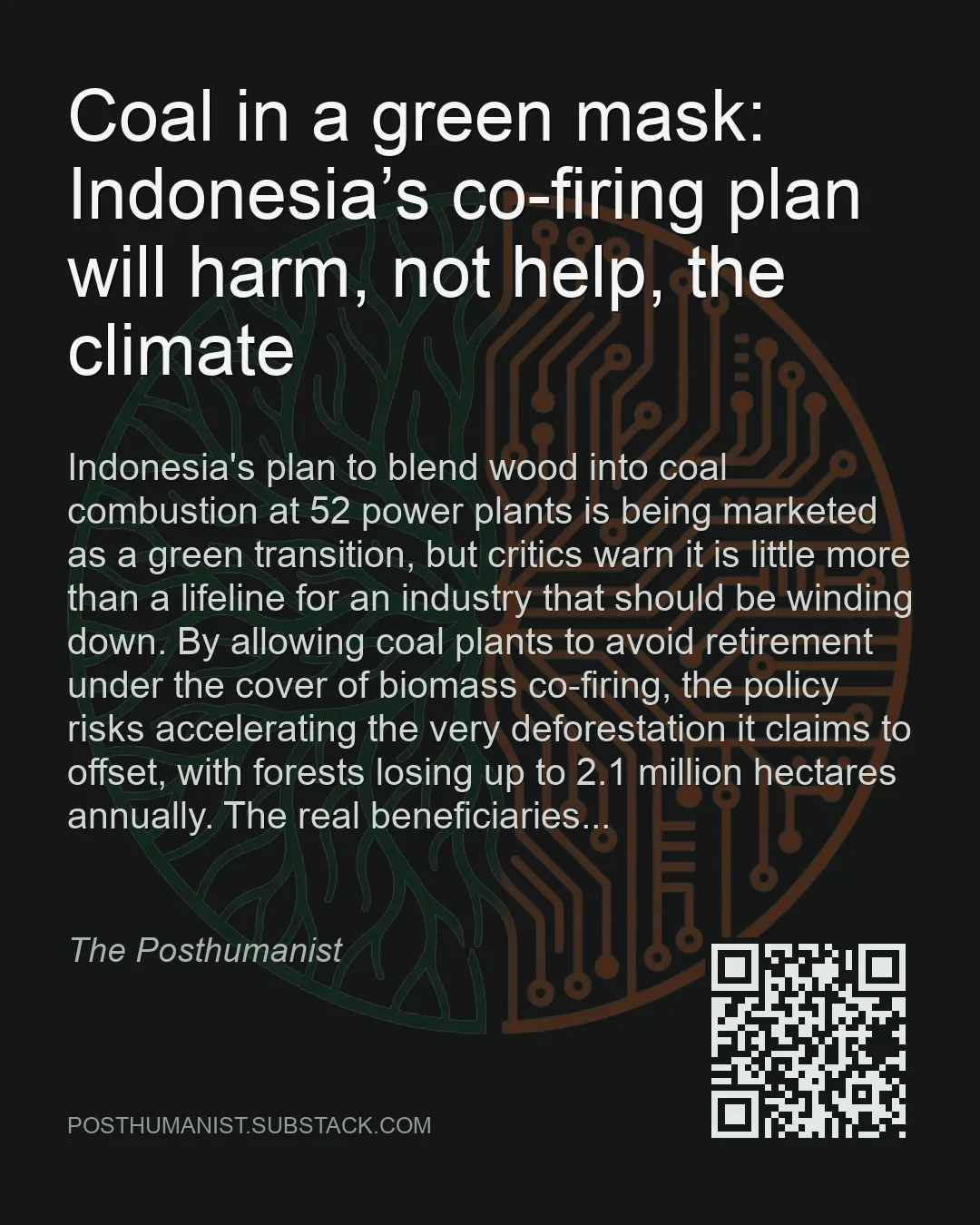
Coal-fired power plants have secured a dubious place in Indonesia's renewable energy strategy through a plan to "carbonize" their smokestacks by firing up wood. This policy tweak may seem like a step in the right direction but ultimately keeps the polluters operational for longer.
Biomass co-firing, which involves mixing a small amount of wood or other plant matter into the coal burn, is expected to enable about 52 coal-fired plants to continue running, despite Indonesia's promise to raise the share of renewables in the energy mix to 23%.
The goal is to transition power plants to renewable energy in a period of three decades. However, the timeline has slipped to 2031. Most power plants won't need significant machinery changes.
Yet, biomass co-firing remains an opportunity for coal plants to stay operational forever, providing them with an excuse to avoid retirement.
This policy perpetuates Indonesia's deforestation problem. The nation's forests are among its most valuable assets but also among the most threatened natural wonders.
At this rate, Indonesia could lose up to 2.1 million hectares of forest each year.
While proponents say that wood is a clean fuel, as trees can grow back, their approach often comes at the cost of releasing decades worth of accumulated carbon into the atmosphere, mainly through clearing of undisturbed natural forest habitats.
Government initiatives, including rules allowing companies with existing industrial timber plantation permits to convert these into energy plantations, have facilitated the rapid expansion of biomass in the timber industry.
In reality, this push primarily serves the interests of the same major companies with a history of clear-cutting forests, including APP Group and Barito Pacific, which have been accused of devastating Indonesia's ecology.

Comments